Friday was an absolute bloodbath. I have been expecting weakness into the end of October, but Friday’s 4.5% cliff dive was spookier than I imagined. AI tech got absolutely slammed, with many of its key players down huge. It seems that what is driving this selloff is almost entirely earnings fear surrounding the AI trade. The market is worried that AI won’t pay off, concerned about the massive spending happening across the space, and increasingly aware of just how much of the entire stock market is being propped up by AI.
What’s wild about all of this is that Big Tech earnings seem to be telling us that spending is going to continue, and continue aggressively. I understand punishing the hyper-spenders for that spending. But the picks and shovels companies got obliterated as well in an indiscriminate AI slaughtering.
QQQ Daily Chart

It seems to me that this sentiment-driven selling is simply a much-needed reset after the AI exuberance we saw in the spring. Once this selling is over, the market will likely become much more selective about the AI winners and losers. The days of buying any and every AI-related company and getting rewarded are long gone.
There is always the concern that this turns into a broad, fear-based liquidity event where everyone runs for the exits at the same time. However, I see several reasons why, barring an actual black swan event, this pullback could be closer to the end than the beginning.
I still will be protecting more aggressively and approaching the market with more caution, especially since the 2018 analog and the 2026 SPY analog I have been tracking are still very much in line with price action. Both could still be playing out. If we start breaking the 200-day SMA on QQQ, the probability of that larger downside scenario increases considerably.
However, if the 200-day SMA holds, or we break below it for a day and then reclaim it a day or two later, I think we could still see a push higher into year-end.
SPY Daily Chart

One reason I think that we are nearing a low is that the entire market is not selling off. We are still in the rotational market that started on June 5th. This is largely AI panic, not broad market panic. In fact, money is moving into consumer-facing names right now, with WMT and COST pushing higher and XLP, the consumer staples ETF, pushing into new all-time highs.
Since this market has been all about rotation, one possible play would be to sell some of those names that have just made new highs and start looking at tech over the next three weeks. We have seen this rotation play out several times since June 5th, with money moving out of one area of the market and back into another. There is a chance we see that happen again.
XLP Daily Chart

The Days After a 4% Down Day on QQQ
I went back through the history of what happens when QQQ makes a 4% move lower in a single day. I know Friday did not officially close down more than 4%, but I started this analysis before the market closed. Given the massive gap lower in QQQ, I still think the data is relevant.
What I found going back to the inception of the ETF is that there are essentially two scenarios that tend to play out.
The first is that we are in a bear market and things are about to get really nasty, really quickly. We saw this during the 2001 crash, the 2008 GFC, COVID, and the 2022 bear market.
Outside of those major events, however, the appearance of a 4% down day has often been followed by a durable low just days later.
The big issue for risk management is that even when durable lows are only days away, the sessions immediately following that initial selloff can bring some serious volatility. In some cases, QQQ has dropped as much as another 10-17% from the initial 4% down-day close before reaching its ultimate low.
A perfect example of this is the Liberation Day crash in 2025.
Thursday, April 3rd, gave us a gap lower and a 5.25% down day. The next two trading sessions brought another 10% decline, with the ultimate low arriving that Monday, April 7th.
QQQ Daily Chart 2025

Another example was the August 24th, 2015 drop, known as Black Monday. That selloff was driven by fears surrounding China’s economic slowdown and Fed policy. After QQQ dropped 4.4% on Friday, August 21st, it fell as much as another 17% intraday on Monday. That marked the low, but wow, nobody wants to be holding overnight when that kind of madness hits.
QQQ Daily Chart 2015

While we did not officially close down more than 4% on Friday, I still think the historical comparison is worth considering.
Looking at the instances where QQQ experienced a move of this magnitude, eight times in its history the selling was followed by a durable low relatively quickly. Four times it was the beginning of something much bigger.
That puts the odds and the historical precedent in favor of finding a bottom around the beginning of November. But that does not mean we cannot go considerably lower before getting there.
There is still a real risk that this develops into a much larger selloff. Many key technical levels have been broken, and real damage has been done to these charts. Be sure to respect the volatility, manage downside risk aggressively, and keep losses small. There will absolutely be opportunities coming out of this selling, but you have to stay in the game and protect your capital long enough to take advantage of them.
Earnings Could Keep Pressure On
We have another round of major earnings coming this week, and considering how badly tech has been punished throughout earnings season, there is certainly a risk that the selling continues.
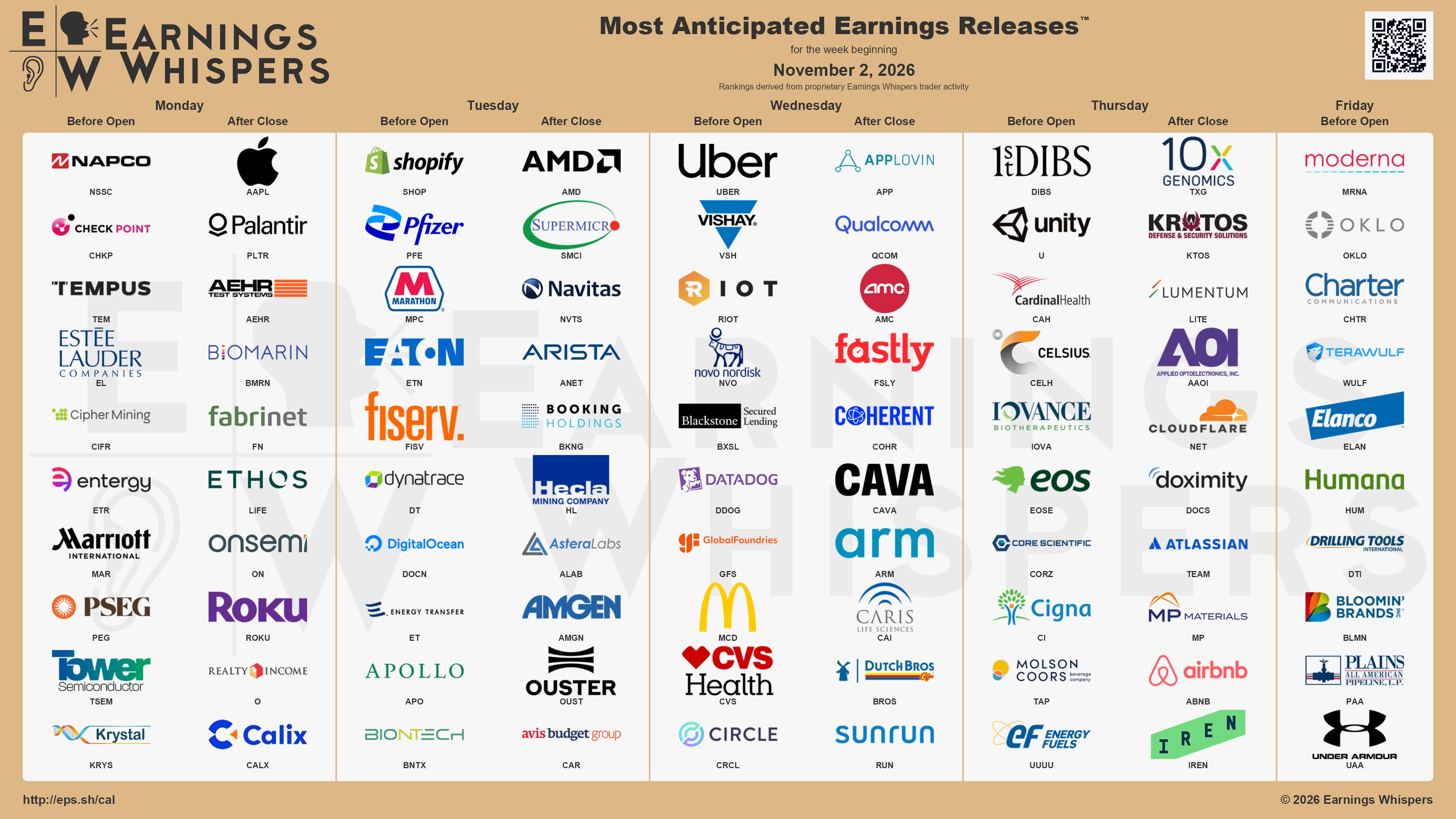
AAPL reports Monday and is sitting near all-time highs. A breakdown there would be another blow to the market.
However, AAPL is currently being viewed as an escape from the AI hyperspenders. It has been moving inversely to QQQ lately, which gives us some hope that it can continue holding up even if the rest of tech struggles.
That relationship will be worth watching closely. If AAPL can hold its strength while the AI trade continues to unwind, it would be another sign that this is still a rotational market rather than a broad-based liquidation.